
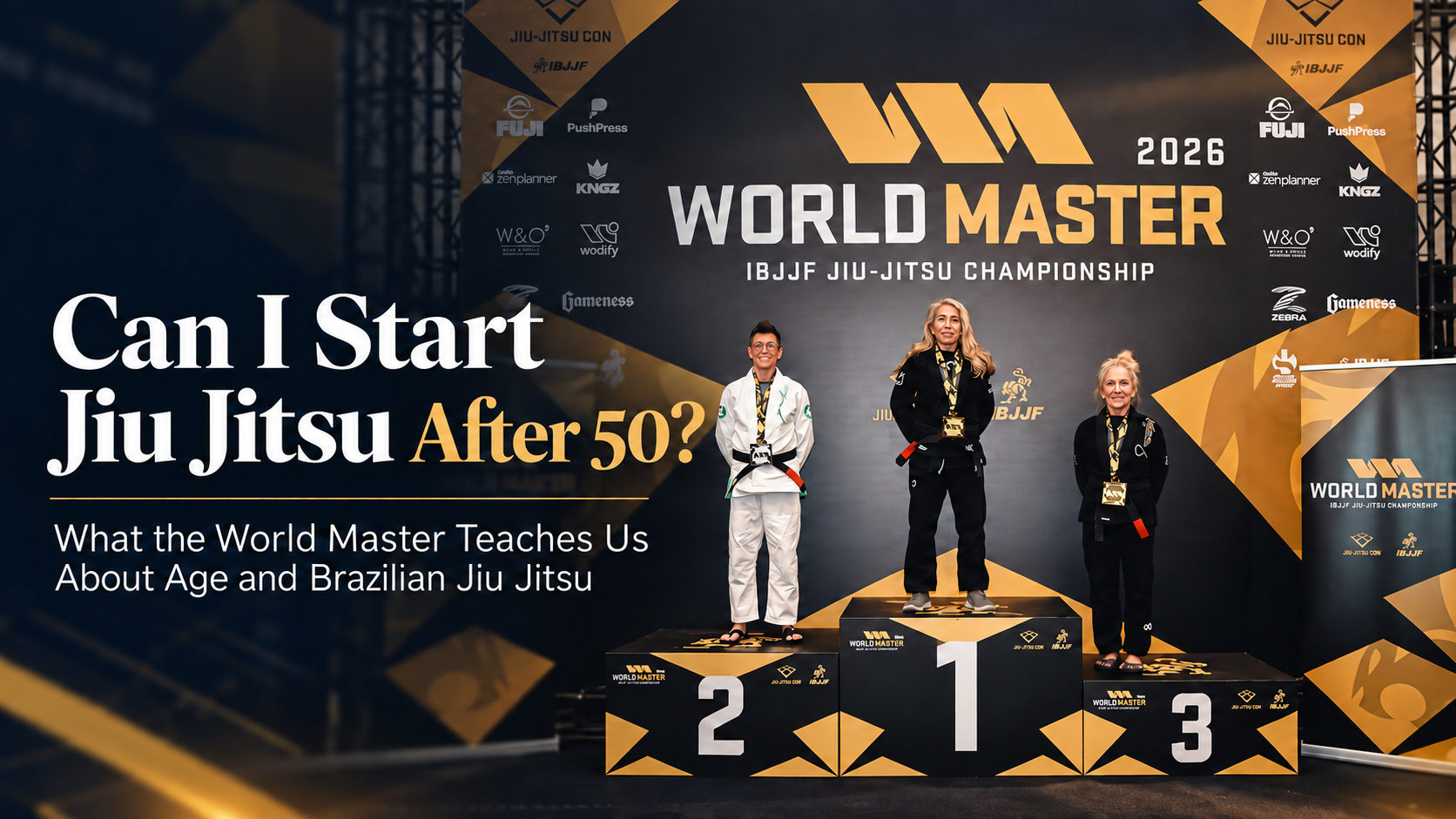
If you are over 45 or 50 and have ever searched “Jiu Jitsu near me,” chances are another question crossed your mind before you ever walked into an academy: Am I too old to start Brazilian Jiu Jitsu?
It is an understandable question. When most people think about combat sports, they imagine young athletes, intense training sessions, competitions, and people who have been practicing martial arts since childhood. Someone who is 50, has a career, a family, responsibilities, and perhaps hasn’t exercised consistently in years may look at that world and think that the opportunity has already passed.
But Brazilian Jiu Jitsu tells a very different story.
One of the most interesting things about Jiu Jitsu is that the sport can evolve with the person practicing it. A 20-year-old competitor and a 50-year-old beginner may share the same mat, but they don’t necessarily have the same goals or need to train in the same way. Jiu Jitsu is built around technique, leverage, timing, positioning and problem-solving. As we get older, those elements become even more important.
And if you want to see just how far a Jiu Jitsu journey can continue, there is perhaps no better example than the IBJJF World Master Jiu-Jitsu Championship.
Can You Really Start Jiu Jitsu After 45 or 50?
The simple answer is yes: many people begin Brazilian Jiu Jitsu later in life.
The more important answer, however, is that starting later requires the right mentality.
You don’t need to walk into your first class and train like the 22-year-old competitor standing next to you. You don’t need to prove how strong you are, and you certainly don’t need to “win” your first rounds.
You need to learn.
In the beginning, that means understanding how to move, how to protect yourself, how the basic positions work and how to become comfortable in situations that initially feel completely unfamiliar. Your conditioning develops with time. Your understanding of the sport develops with time. Your confidence develops with time.
For adults starting after 45 or 50, consistency is usually far more valuable than intensity.
Training two or three times every week for years can take you much further than training as hard as possible for one month and then disappearing because your body cannot recover.
This is also why choosing the right academy and training partners matters. A good instructor understands that the person beginning Jiu Jitsu at 50 may have completely different objectives from a young professional competitor.
The mat has room for both.
You Don’t Need to Get in Shape Before You Start
We hear another version of the same concern all the time:
“I want to try Jiu Jitsu, but first I need to get in shape.”
For many people, that becomes an endless cycle. They wait until they lose weight, become stronger, improve their cardio or feel more flexible — and the first class never happens.
You don’t need to arrive at a Brazilian Jiu Jitsu academy as an athlete. You arrive as a student.
Your conditioning can improve through training. Movements that feel difficult during your first few weeks can gradually become familiar. Your body begins adapting to something new.
Of course, age also makes intelligent training increasingly important. Recovery matters. Mobility matters. Strength matters. Previous injuries matter. Anyone with significant health concerns or physical limitations should speak with an appropriate healthcare professional before beginning strenuous exercise.
But being older does not automatically mean there is no place for you on the mat.
In fact, every year thousands of Master athletes demonstrate exactly the opposite.
Then You Walk Into the IBJJF World Master
Every year, Brazilian Jiu Jitsu athletes from around the world travel to compete in the IBJJF World Master Jiu-Jitsu Championship.
In 2026, that journey brought the Jiu Jitsu community once again to Las Vegas.
For someone who has never experienced the World Master, it can completely change the way you think about age and martial arts.
You walk through the venue and see mat after mat filled with competitors. Different belts. Different countries. Different weights. Different backgrounds.
But what makes this championship especially interesting is age.
The official 2026 World Master results included divisions extending from Master 1 all the way through Master 7.
These aren’t simply young professional athletes whose entire lives revolve around competition.
Many Master competitors have careers. They have businesses. They have children and grandchildren. They have responsibilities outside the academy. Some have practiced Jiu Jitsu for decades, while others discovered the sport much later.
Yet there they are, stepping onto the mat.
And suddenly the question “Am I too old for Jiu Jitsu?” starts to look very different.
What We Saw at World Master 2026
Athlas Training Team had the opportunity to experience the 2026 IBJJF World Master firsthand, traveling from Fort Lauderdale to Las Vegas with our athletes and coaches. Being there gives you a completely different perspective on what a major Jiu Jitsu championship really represents. The matches may be what everyone sees, but they are only a small part of the story.
Behind every athlete who steps onto the competition mat are months of preparation, countless hours of training and a commitment that extends far beyond competition day. There are early mornings at the academy, difficult training sessions, recovery, nutrition, travel, weight management and all the emotions that come with preparing for an important tournament. By the time an athlete’s division is called in Las Vegas, a much longer journey has already taken place.
This becomes even more meaningful at the World Master because many of these competitors are balancing Jiu Jitsu with careers, businesses, families and everyday responsibilities. They continue to make time to train, improve and challenge themselves year after year. Walking through the venue and seeing athletes across so many Master divisions is a powerful reminder that Brazilian Jiu Jitsu can remain part of someone’s life for decades.
For us, that was one of the most inspiring parts of World Master 2026. It wasn’t simply about who won a match or stood on the podium. It was about seeing what consistency can look like over time. In Brazilian Jiu Jitsu, progress doesn’t happen in a single tournament or training session. It is built through years of learning, adapting and continuing to show up.
Athlas From Master 1 to Master 7
For Athlas Training Team, the World Master has become much more than just another competition on the calendar. For years, our academy has encouraged Master athletes to continue setting goals, challenging themselves and experiencing competition, regardless of age. We believe that having something to work toward can bring a new level of purpose to training, whether that goal is competing at a World Championship, earning the next belt or simply continuing to improve year after year.
The 2026 World Master was another special chapter in that journey. Isaac Manu Sankersingh represented Athlas in the Master 1 Purple Belt Medium Heavy division and became IBJJF World Master Champion after six matches. After completing that journey and reaching the top of the podium, the moment became even more meaningful when he was promoted to brown belt on the podium, marking both the end of one chapter and the beginning of another in his Jiu Jitsu journey.
But the Athlas presence at World Master 2026 also represented something much bigger than one championship result. Our athletes competed across very different stages of the Master divisions. Rand Louis Currier earned a bronze medal in the Master 6 Blue Belt Feather division, while Melody Ridgley-Fortunato earned bronze in the Master 7 Black Belt Feather division.
Seeing Athlas represented from Master 1 through Master 7 reflects something we have believed in for years: getting older does not mean you have to stop setting athletic goals. Those goals may change with time, and the way you train may change as well, but the motivation to learn, improve and challenge yourself can remain.
That is one of the reasons Athlas continues to support and encourage our Master athletes to compete. The value of preparing for an event like the World Master goes far beyond medals. It gives athletes a reason to stay consistent, take care of themselves, remain connected to their teammates and continue working toward something meaningful.
For someone who is 45, 50, 60 or older and wondering whether there is still a place for them in Brazilian Jiu Jitsu, our experience in Las Vegas offered a powerful answer. From a Master 1 athlete winning a World title and receiving his brown belt on the podium to Master 6 and Master 7 athletes continuing to step onto the competition mats, the journey may look different at every age, but it can continue.
Brazilian Jiu Jitsu is not defined by when you started. What matters is that you keep finding reasons to continue.
Come With Us to World Master 2026
We documented our experience in Las Vegas because we wanted people to see more than simply competition results.
[EMBED VIDEO: WORLD MASTER 2026 WAS INSANE! | IBJJF JIU-JITSU IN LAS VEGAS]
In the video, you can experience some of what happens around a championship of this size — the atmosphere, preparation, competition, coaching and life behind the scenes.
And when you watch it, don’t look only at who wins.
Look around the mats.
Look at the athletes.
Look at the ages.
Look at how many different people have found a place for Jiu Jitsu in their lives.
That is the bigger story.
But What If I Don’t Want to Compete?
Then don’t.
This is perhaps one of the most important things for someone considering starting Brazilian Jiu Jitsu later in life to understand.
World Master is an example of what is possible. It is not a requirement.
You can practice Jiu Jitsu for years and never compete once.
For some people, competition provides a goal. They enjoy preparing, testing themselves and seeing where their technique stands under pressure.
For someone else, the reward is completely different.
Maybe you are 52 and want to train twice a week after work.
Maybe you want an activity that keeps your mind occupied for an hour.
Maybe you want to learn a martial art you have watched for years.
Maybe your goal is to stay active as you get older.
Maybe you simply enjoy being around people who are working toward something positive.
None of those goals is less meaningful because there isn’t a medal attached to them.
The World Master athlete and the 50-year-old white belt taking a first class are at completely different points of the journey.
But both belong on the mat.
Jiu-Jitsu Con: Seeing the Bigger Jiu Jitsu Community
Our trip to Las Vegas wasn’t only about World Master.
We also documented our experience around Jiu-Jitsu Con 2026, giving another perspective on how large and diverse the Brazilian Jiu Jitsu community has become.
JIU-JITSU CON 2026 WAS INSANE | NO-GI, LEGENDS & BEHIND THE SCENES]
When someone first searches “Brazilian Jiu Jitsu near me,” they are usually looking for a place to train.
What they may not realize yet is that they are potentially walking into a much larger community.
Jiu Jitsu connects people who otherwise might never have met.
Different ages train together. Different professions train together. People from different countries meet throu
